Why Is Marketing Mix Model (MMM) Validation So Hard? (And Why Most Teams Evaluate It Wrong)
Can you trust your MMM's results and recommendations? The typical mistakes teams make when evaluating MMMs — plus a five-level framework for validating them properly.
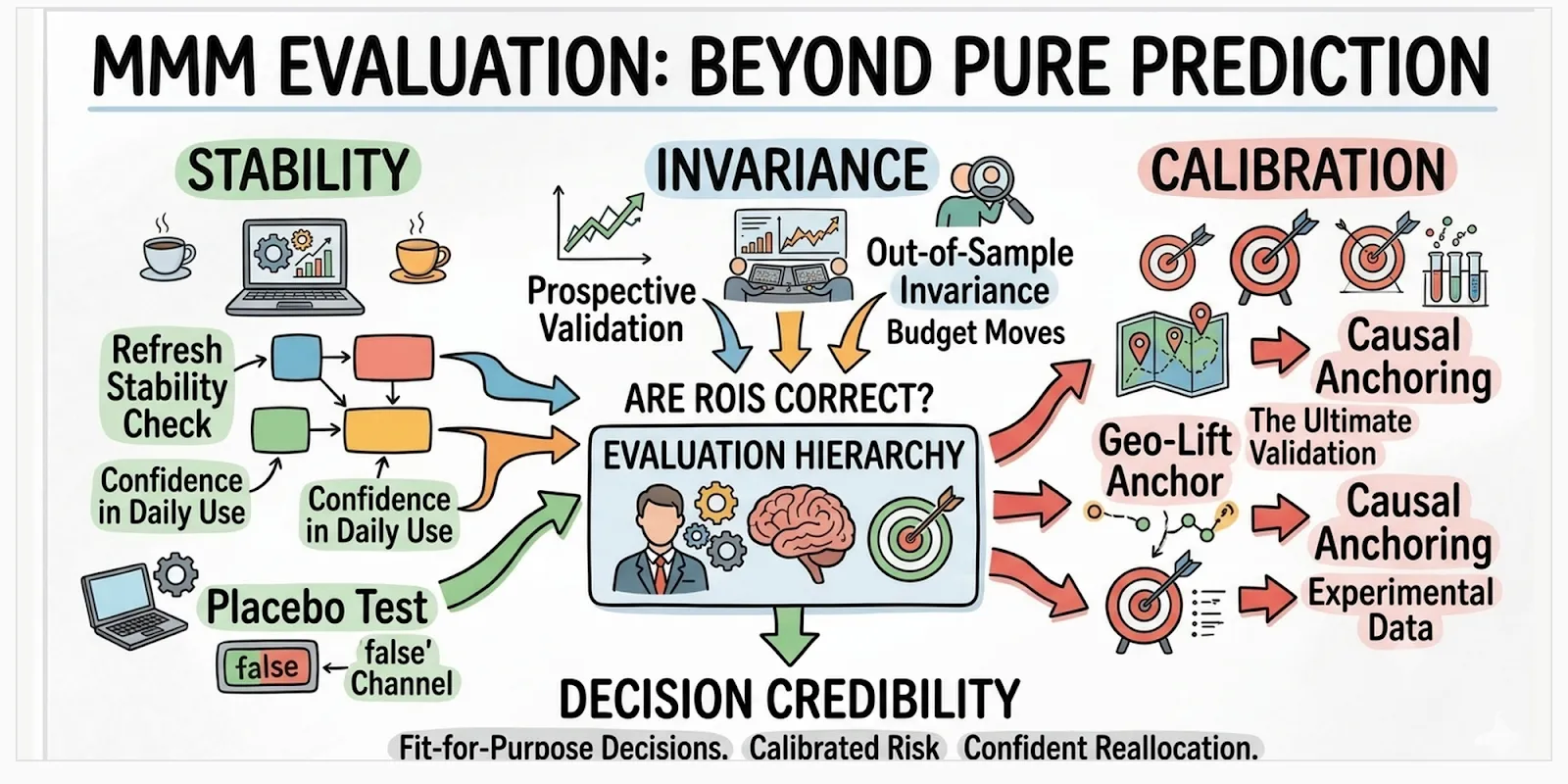
If you have ever been pitched a Marketing Mix Model (MMM), you have likely heard claims like: “Our model achieves 95% predictive accuracy,” or “Our algorithm passed out-of-sample validation with flying colors.”
To a CMO or analytics director trying to justify millions in media spend, these scores sound reassuring. In standard machine learning, a high accuracy score on unseen data is the holy grail.
Here is the uncomfortable truth that MMM vendors rarely admit: a model can achieve outstanding predictive accuracy while being completely wrong about channel ROIs and budget recommendations.
Evaluating an MMM is fundamentally harder than evaluating a standard forecasting or predictive model. When analytics teams evaluate an MMM using traditional data science instincts — or when marketing leaders rely on a single vendor-supplied metric — they often end up trusting budget reallocations that destroy business value.
Understanding why MMM validation is so counterintuitive is critical to evaluating models correctly and making confident spend decisions.
1. The core paradox: prediction vs. causal intervention
The fundamental reason MMM evaluation is hard comes down to a distinction made famous by statistician Galit Shmueli: the difference between predicting outcomes and explaining causal interventions.
- A forecasting model answers: “Given current trends, seasonality, and planned spend, what will our revenue be next month?”
- An MMM answers: “If I cut $1 million from Linear TV and shift it to Paid Search, what happens to revenue?”
Forecasting models care only about correlation. If sales increase every December alongside rising TV spend, a forecasting model doesn’t care whether TV caused the sales or if holiday demand caused both. It gets the forecast right either way.
An MMM, however, is an interventional tool. It relies on causal inference. If your model mistakes holiday seasonality for TV effectiveness, its forecast for December will look brilliant, but its budget recommendation — to pour millions more into TV — will fail completely.
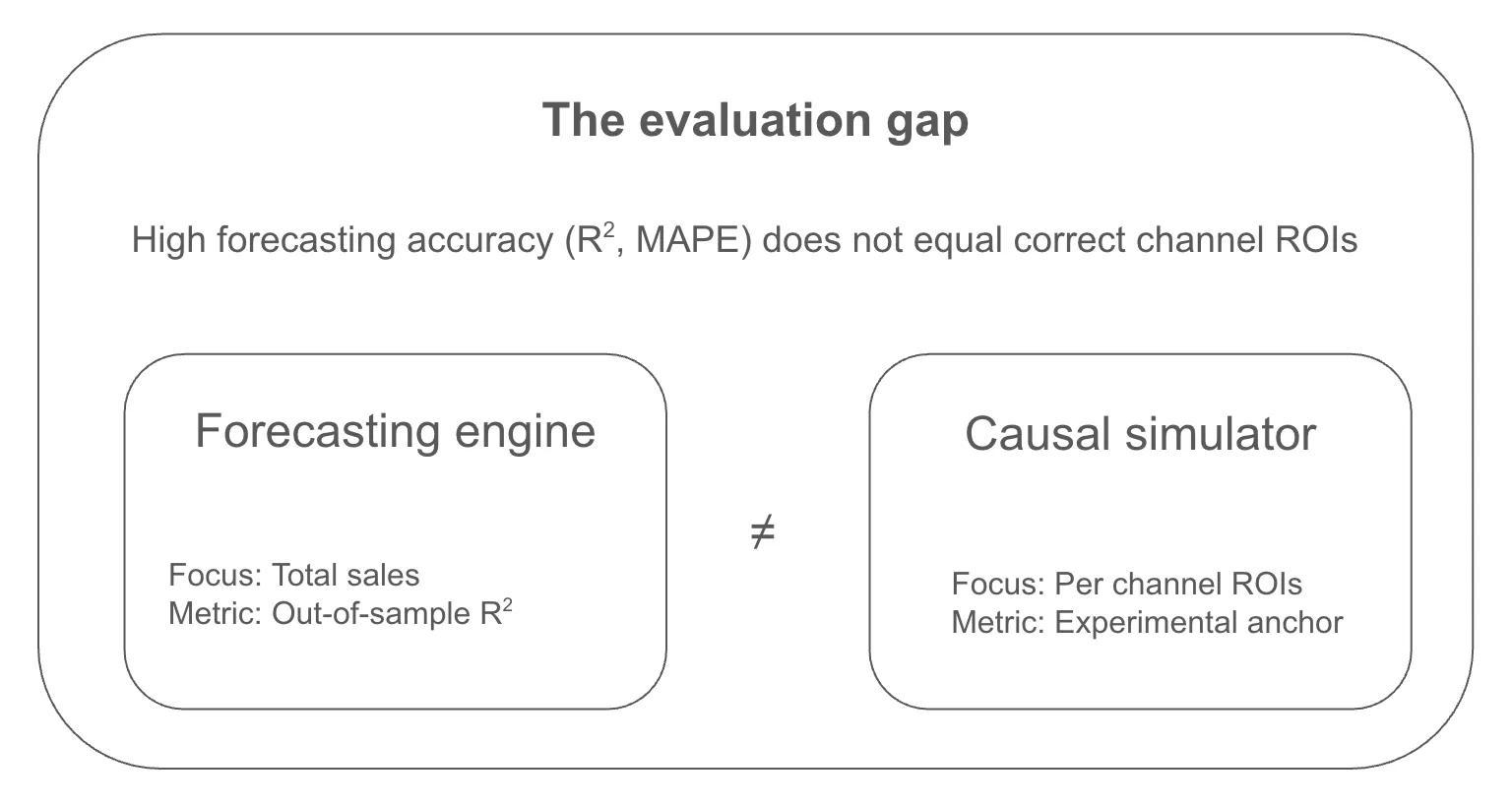
Because true causal validity cannot be measured directly from historical data alone, evaluating an MMM requires indirect proxies. When teams treat predictive accuracy as a direct proxy for causal truth, they fall into major structural traps.
2. Three fatal evaluation traps
When business leaders and analysts evaluate MMMs, three common traps obscure flawed model outputs.
Trap 1: The aggregate fit illusion
Marketing teams act on per-channel incremental ROIs, not total sales numbers. However, traditional goodness-of-fit metrics — like R², Mean Absolute Percentage Error (MAPE), or Normalized Root Mean Squared Error (NRMSE) — are computed at the aggregate total revenue level.
Aggregate metrics hide offsetting channel-level errors.
Imagine a scenario where a model overestimates the impact of Paid Social by $500,000 while simultaneously underestimating the impact of Broad Broadcast TV by $500,000.
At the aggregate level, those errors perfectly cancel out. The overall revenue fit looks flawless, showing an R² of 0.94. But the channel-level recommendations are dangerously flawed, instructing you to pull funds from your most profitable channel to fund an underperforming one. A green aggregate fit metric provides zero guarantee that the underlying channel decomposition is correct.
Trap 2: The confounder trap (gaming the metric)
If predictive accuracy were the ultimate test of an MMM, the easiest way to build a “great” model would be to include variables that capture purchase intent.
Adding variables like branded search clicks, direct traffic, or promotional coupon redemptions into an MMM almost always dramatically improves in-sample R². These variables correlate strongly with sales.
However, they are often downstream outcomes of marketing spend, not independent drivers. Branded search clicks happen because a consumer saw an ad on TV, social media, or online video.
When you include branded search as an explanatory channel, the model assigns sales credit to the search click rather than the upper-funnel media that drove the search. Predictive fit skyrockets, but causal attribution collapses, systematically cannibalizing credit from upper-funnel investments.
Key rule: a variable that improves prediction accuracy can actively ruin causal identification.
Trap 3: Chasing out-of-sample (OOS) holdouts without mix heterogeneity
In standard machine learning, holding out 20% of the data to test predictive accuracy is standard practice. In MMM, out-of-sample holdout validation is valuable, but it is frequently misunderstood and easily gamed.
- The spend-mix problem: If your media spend across channels remains relatively stable week-over-week, an out-of-sample holdout test is just another test of baseline trend and seasonality forecasting — not a test of channel effectiveness. A model can pass a holdout test with high scores while remaining completely wrong about individual channel ROIs.
- The spiky holdout trap: On shorter datasets (e.g. 2 years of weekly data), holding out a contiguous 10-week period at the end of the time series often swallows a major seasonal event like Black Friday or holiday sales. Models evaluated or tuned strictly on out-of-sample performance can artificially degrade their sensitivity to true seasonal spikes just to optimize a holdout score, landing on degenerate solutions.
Out-of-sample performance serves as a useful negative filter (vetoing models that overfit severely), but it should never serve as the primary selection criterion for determining channel ROIs.
3. The three industry schools of MMM validation
The MMM ecosystem has split into distinct philosophies regarding how to evaluate model health in the absence of continuous randomized experiments — i.e. when the model needs to be evaluated using indirect proxies. Understanding these various “schools” helps clarify vendor claims and trade-offs.
| School | Primary validation proxy | Core argument | Greatest blindspot |
|---|---|---|---|
| Bayesian Generative (e.g. Google Meridian) | Structural plausibility, prior alignment, and Bayesian health checks. | Causal validity relies on correct DAG structures, negative-baseline checks, and experiment-calibrated priors. Overfitting can be acceptable if causal estimates are unbiased. | Can become a closed loop where a model looks mathematically healthy but simply reflects weak assumptions if priors are uncalibrated. |
| Interventionist | Out-of-sample invariance under a changing media mix. | A model whose predictive accuracy remains stable across changing spend environments has likely captured real causal mechanics. | Weakened when spend-mix changes are minimal; highly volatile periods can cause valid causal models to fail holdout tests. |
| Software Governance | Invariance, refresh stability, noise robustness, and falsification. | Models used for corporate budget planning must be stable across updates and robust against real-world data noise. | A model can be stable, noise-resistant, and pass placebo tests while remaining systematically biased about true ROI. |
Rather than viewing these approaches as contradictory, sophisticated analytics teams view them as complementary layers:
- Bayesian Generative checks confirm internal mathematical sanity and structural alignment.
- Software Governance checks ensure parameter stability so recommendations don’t flip wildly when four weeks of new data are added.
- Interventionist testing checks how well the model handles actual budget shifts over time.
4. How to evaluate an MMM correctly: a decision hierarchy
If aggregate R² is insufficient and single metrics can be misleading, how should marketing and analytics leaders judge whether an MMM is trustworthy?
Evaluation should follow a clear hierarchy. Failures at higher levels cannot be rescued by strong scores lower down.
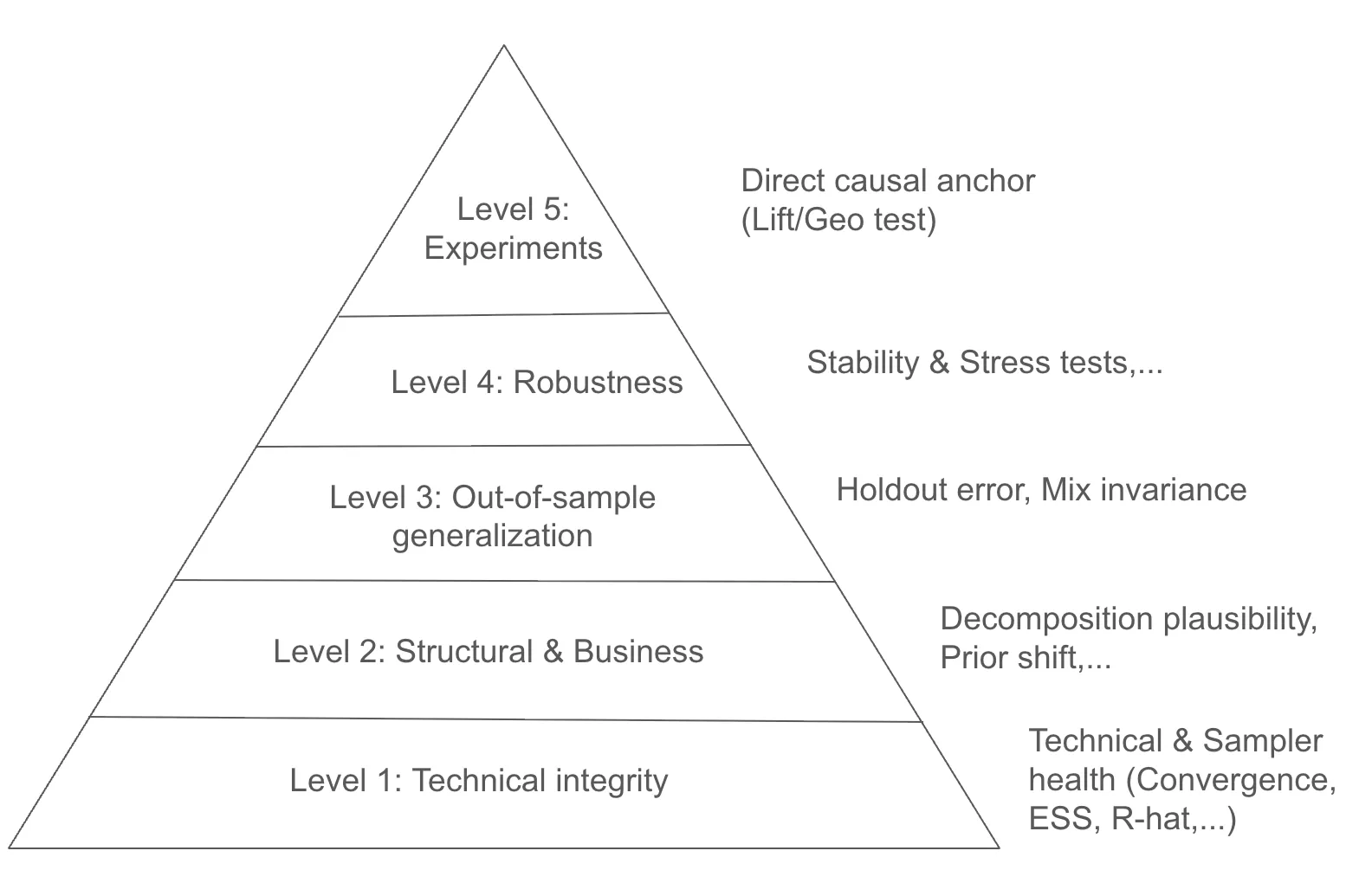
Level 1: Technical & sampler integrity (the floor)
Before examining ROIs, verify basic numerical execution. Did the Bayesian sampler converge cleanly (e.g. R-hat < 1.05)? Did the frequentist optimizer stabilize on a valid Pareto front without hitting artificial hyperparameter bounds? If a model fails technical execution, no downstream outputs can be trusted.
Level 2: Structural & decomposition plausibility (Bayesian Generative School)
Examine the internal physics of the model before looking at prediction scores.
- Baseline realism: Does the non-paid baseline represent a plausible share of revenue, or is media claiming 95% of sales in a mature business?
- Prior-to-posterior shift: Did the data actually update the channel priors, or are ROI estimates just echoing default assumptions?
- Directional signs & diminishing returns: Are paid channel contribution curves positive and demonstrating realistic saturation shapes?
Level 3: Out-of-sample generalization & mix invariance (Interventionist School)
Test how the model performs on unseen data and historical spend shifts.
- Chronological holdout veto: On a modest holdout window (e.g. 10–15% tail), does the model maintain acceptable prediction error (MAPE / CRPS)? Severe holdout degradation acts as a hard veto against overfitting.
- Invariance under shift: When evaluated across periods where media spend mix actually changed, does prediction accuracy remain stable? (Note: OOS accuracy serves as a negative filter to reject bad models, not a selector to pick the highest score.)
Level 4: Stability & robustness stress-testing (Software Governance School)
A reliable decision engine should not be hyper-fragile under everyday operational use.
- Refresh stability: When you add four weeks of new data, do channel ROIs remain reasonably stable, or do they flip wildly?
- Noise robustness: If 5% Gaussian noise is injected into spend inputs, do channel ROIs stay bounded?
- Placebo / falsification tests: If you introduce a fake, scrambled spend variable, does the model correctly assign it near-zero impact?
Level 5: The apex anchor — calibration against experiments
The only direct validation of a channel effect is a randomized, designed experiment — such as a geo-lift test or a conversion holdout campaign. Everything else in model evaluation is an indirect proxy. A model calibrated against real-world incrementality experiments carries vastly more decision-making authority than an uncalibrated model with a high R² score.
5. Moving to a “fit-for-purpose” credibility mindset
Organizations often make the mistake of treating model credibility as binary: a model is either “accurate” or “useless.”
A more realistic approach maps model credibility tiers directly to the financial risk of the decisions being made.
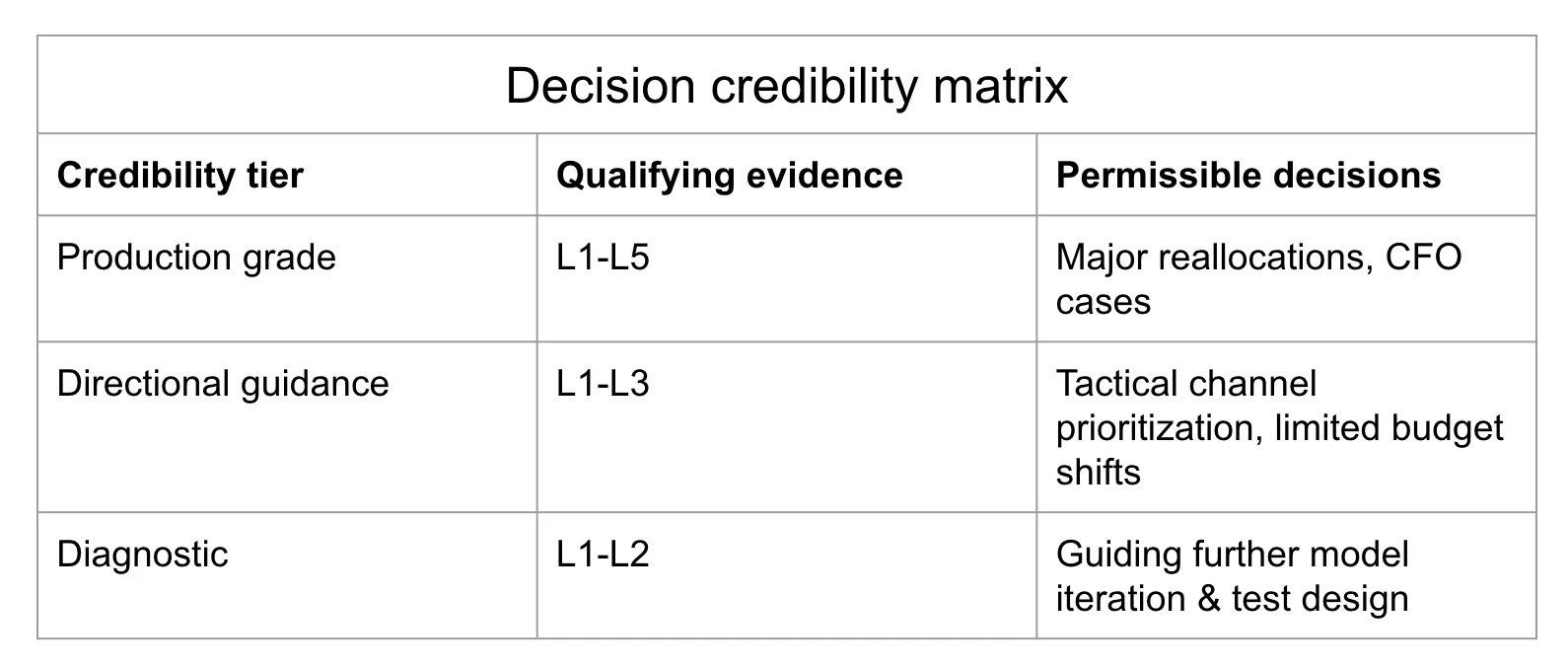
You do not always need a fully calibrated “production-grade” model to start extracting value. A “directional guidance” model can help prioritize team focus or guide small tactical adjustments.
The danger lies in using a directional model to execute production-grade budget shifts — such as reallocating 30% of a multi-million-dollar TV budget into digital channels based solely on uncalibrated model outputs.
Redefining how you evaluate your model
When evaluating an internal MMM or reviewing a prospective vendor, push past aggregate accuracy metrics. Ask questions focused on causal credibility:
- “How does the model separate true media impact from downstream intent variables like branded search?”
- “What happens to channel ROIs when we add a month of data or run a noise-injection test?”
- “How much of this channel’s ROI estimate is driven by the data versus our prior assumptions?”
- “How are lift experiments integrated to calibrate channel estimates?”
MMMs are strategic flight simulators, not simple revenue forecasters. By shifting focus from vendor-promoted accuracy metrics to structural plausibility, stability stress-testing, and experimental calibration, marketing leaders can base budget decisions on genuine causal signal rather than statistical noise.